
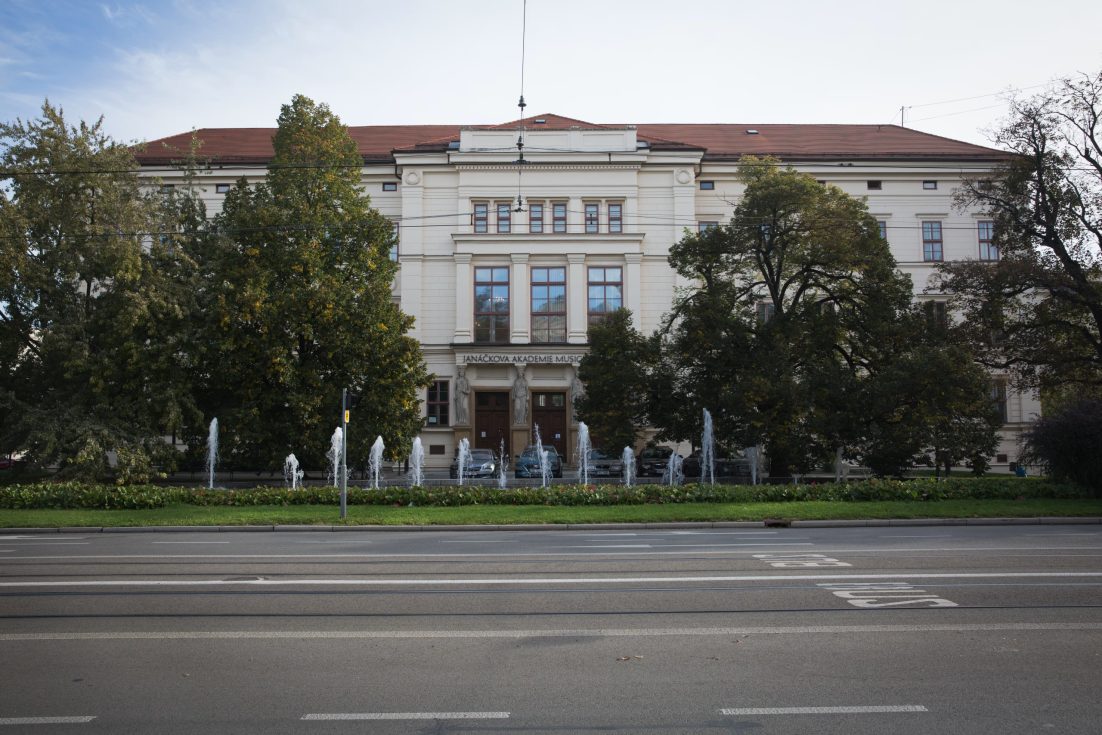
The building, which houses the Faculty of Music of JAMU, is one of Brno’s important architectural monuments and represents a permanent part of the city’s architectural history. It was built for the needs of the German Gymnasium between 1860 and 1862 according to the winning competition design by the Viennese architects Eduard van der Nüll (1812-1868) and August Siccards von Siccardsburg (1813-1868). In Vienna itself, they created, for example, the command building of the Arsenal and, above all, the Court Opera House, today’s State Opera House. They met as students at the Vienna Polytechnic and then at the Academy of Fine Arts, studied together in Italy, France, England and Germany, and were appointed professors at the Academy not long after their return. In their collaboration, Nüll’s tendency towards the decorative was balanced by Siccard’s constructive foundation. However, they never saw the completion of the grandiose Vienna opera. The sensible Nüll could not bear the strain of work and the attacks of the critics and voluntarily ended his life. He was soon followed by his faithful companion.
Nüll and Siccardi found their stylistic inspiration for the gymnasium building, in their time called the “seedbed of science”, in Greek antiquity. The four monumental caryatids on the portico, allegorizing classical education, are a paraphrase of the Erechtheion on the Athenian Acropolis and were created by the sculptor Josef Brenek. The medallions with relief busts of important scientific figures were made by Adolf Loos Sr., the father of the famous architect. The layout of the building was as remarkable as the exterior. The large vestibule with a three-armed staircase, which today houses the bust of Leoš Janáček, created in 1924 by Jan Štursa (1880 – 1925), a prominent sculptor and founder of Czech modern sculpture, demonstrated a representative tendency, accompanied in other areas by a sense of purpose and clarity.
The Gymnasium was built at the time of the demolition of the city walls, when the vacant land was being prepared for the construction of public buildings, residential houses and promenade parks. In 1860, the Viennese architect Ludwig von Förster (1797 – 1863), who had shortly before been the designer of Vienna’s Circular Avenue, was commissioned to draw up the plan. He made use of earlier plans still in the spirit of late classical urbanism, but his design was subject to some modifications due to official comments and public criticism, and was not approved by the city council until 1863. The Gymnasium co-designed the north-western part of the Circular Avenue, where the religious, school, office and cultural buildings gave the character of a representative “government” district. The historic building was used by the JAMU in part from 1949 and in full from 1965. In the mid-1990s the building underwent extensive reconstruction and since 1998 it has been used exclusively for the needs of the Faculty of Music.
(using materials of prof. PhDr. Jan Sedlak, Csc.)