
Basic information
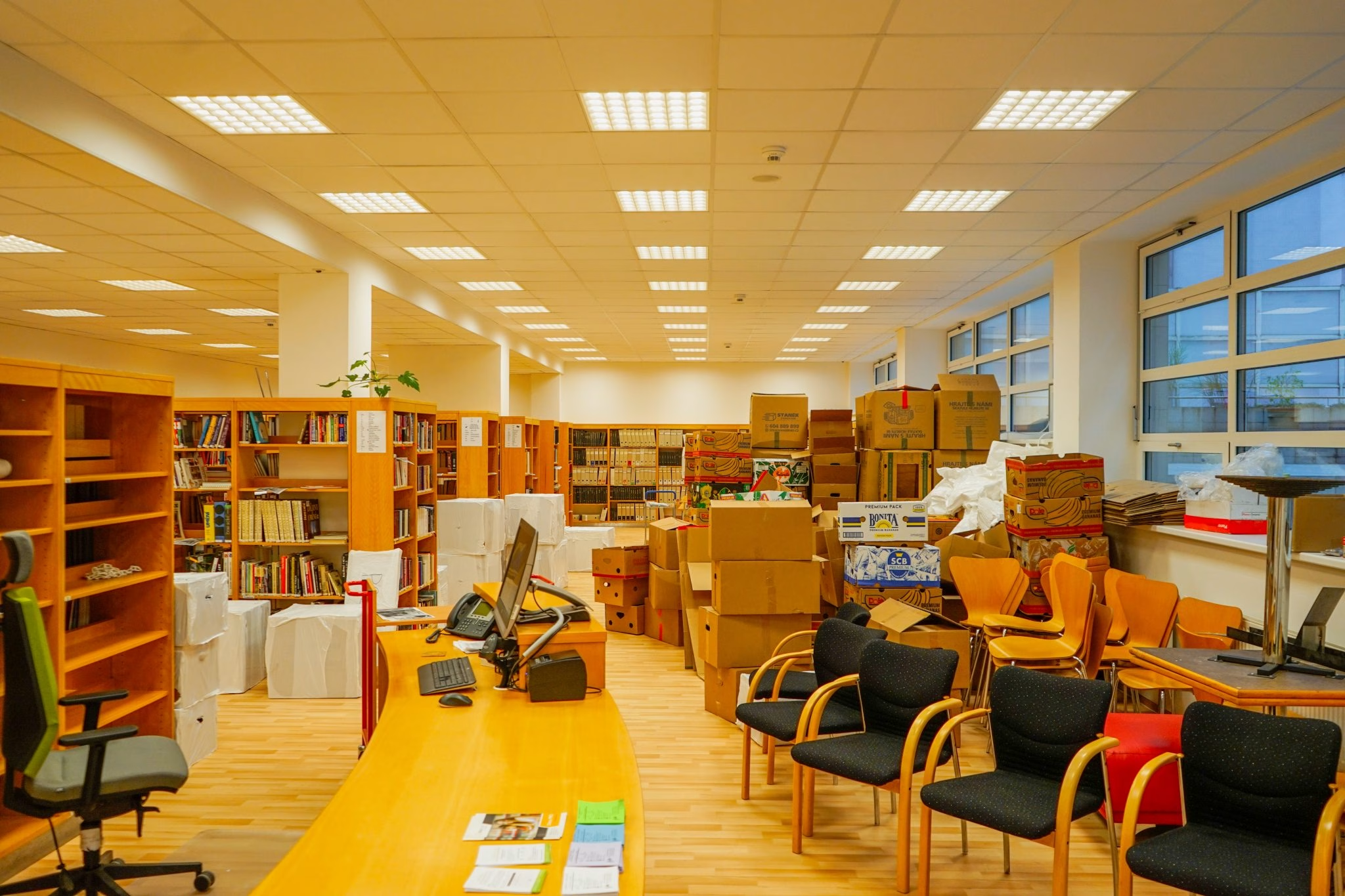
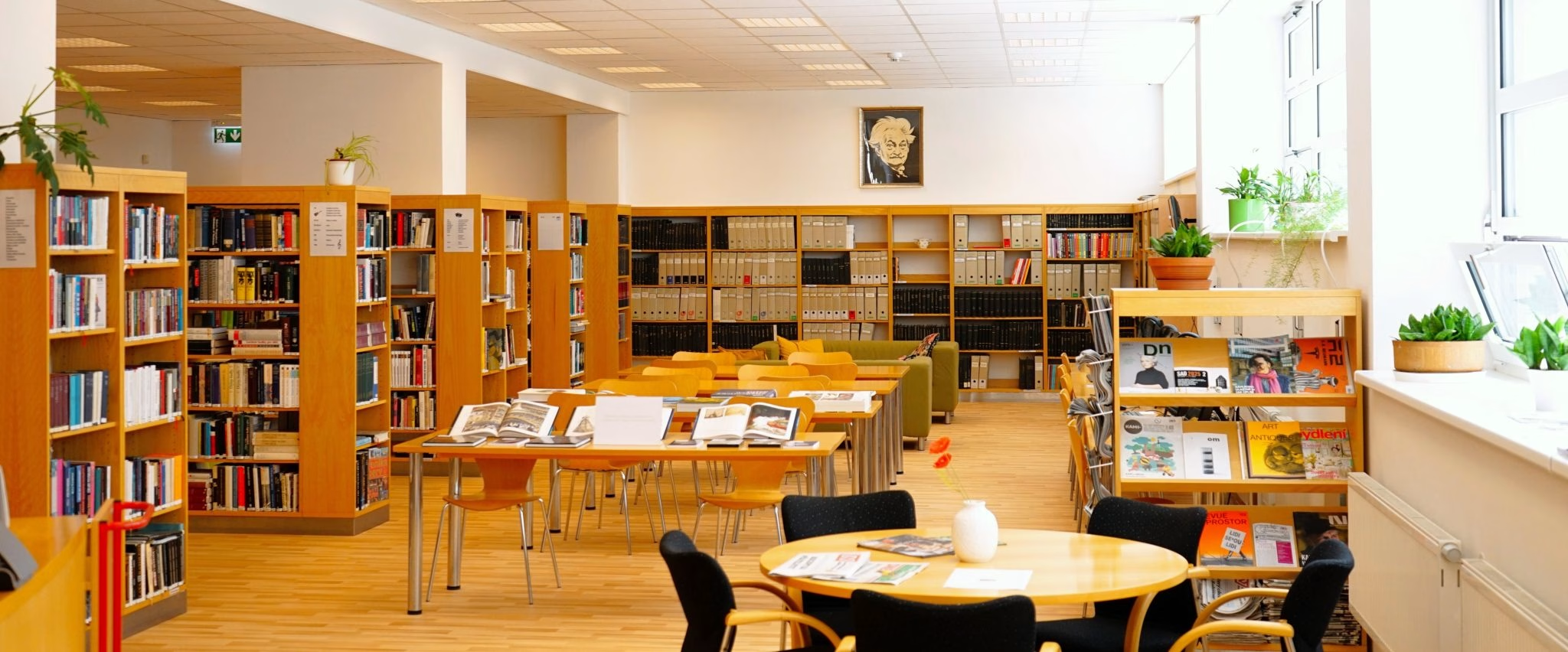
The JAMU Library serves primarily as a support for study, science and research at JAMU. The library provides standard services: lending, information, reprographic, access to licensed electronic information resources, MVS, in addition to selected study literature there are 38 study places with Internet access (also wifi). In the framework of information education, it provides access to Citace.Pro, in cooperation with the faculties it participates in lending music books for student artistic activities. The composition of the library collection is based on the accredited study programmes of the Faculty of Theatre and Music (Dramatic Arts, Dance Arts, Musical Arts), books (including scripts, plays, fiction), music books, magazines, CDs, DVDs, final theses are available for loan. The library includes an Art Documentation Fund.
| 1 – 26 September Reduced opening hours: Mon, Tue, Thu 9 – 16 h Wed 9 – 17 h Fri 9 – 15 h From Monday 29 September normal opening hours: Mon, Wed 9 – 18 h Tue, Thu 9 – 17 h Fri 9 – 15 h More information HERE. |
| Lending library and study room – normal opening hours |
| MON, WED: 09:00 – 18:00 |
| TUE, THU: 09:00 – 17:00 |
| FRI: 09:00 – 15:00 |
| SO, SUN, public holidays (other – see News): CLOSED |
| Need some advice? E-mail: knihovna@jamu.cz Tel. (loan desk): 542 59 2204 |
About the library
In the same year as the establishment of the Janáček Academy of Performing Arts in Brno with the Department of Music and Drama by Act No. 168/1947 Coll. of 12. 9. 1947 the JAMU library also started its activity. Its first location was in the building of the insurance company on Obránců míru 2.
The library collections were systematically built up in accordance with the school’s focus; the basic fields of study in the first and second decade of the school’s existence were: composition and conducting, opera dramaturgy, directing and acting, music theory, playing orchestral instruments (violin, piano, organ, etc.), and opera singing. A significant part of the collection consisted of music books, music catalogues, music and theatre science literature, encyclopaedias, educational and language dictionaries, theatre plays, Czech and world literature, specialist magazines and gramophone records.
In 1965, the library moved to 11 Gorkého Street in the vicinity of the famous Brno Academic Café. Its operations – i.e. the purchase and processing of books and music books, lending services to students, teachers and the theatre and music reading public – were provided by librarians and research assistants. In addition to their own library work, they handled the borrowing of materials for the student theatre scene – Studio Marta, which dates back to the early 1950s, as well as the lending of orchestral materials for student and graduate concerts, the provision of orchestral part schedules, and the procurement of musical materials for the Opera Studio founded in 1957 by Milos Wasserbauer. Another activity specific to the art school library is the processing of archival and documentary materials relating to student theatre and music activities from 1949 to the present.
Significant changes occurred not only for the library after 1989. The house in which the library had operated for almost 25 years was returned to the owner in restitution and then sold to the Czech Insurance Company. At the time of the overhaul in 1992 – 1995, all library collections remained in place, the replacement was in the building of the Theatre Faculty at 1 Mozartova Street, which started teaching on the basis of the decree of the Government of the Czechoslovak Socialist Republic No. 282/1990 Coll. 4. 1990 on the re-establishment of an independent theatre faculty. After the renovation in 1995, the librarians returned to the expanded 265 m 2 area on the first floor.
In the second half of the 1990s, the library, in cooperation with the theatre and music faculty, developed a transformation project that, with the help of the latest technology, was to respond to the new conditions and respect the needs of the school. The lack of modern technical equipment not only complicated the actual library work, but also did not correspond to the current demands on the information process at the university. The Faculty of Theatre expanded the range of study disciplines to include theatre management, dramaturgy, radio and television dramaturgy and scriptwriting, stage design, educational drama for the deaf, the Faculty of Music added studies in sacred music, harpsichord playing, music management, and both faculties opened doctoral studies in the 1993/94 academic year.
Funding for adequate technical equipment was obtained by the library with grants from the Ministry of Education and Science from the University Development Fund in 1996 and 1997. It purchased basic HW and SW, additional technical equipment and the KP-SYS library system.
In 1997, it made available a reading room with a local computer network and a CD and videocassette lecture room.
The aim of these projects was to provide and make available a range of information to teachers and students, to enable quick access to information media through the computer network, and to provide on-site work with all media – the concept of an integrated reading room. The library slowly began to move from the traditional way of working with books to an automated information system. The installation of computers and the subsequent introduction of the modular library system
KP – SYS gradually began to change the behaviour and thinking of librarians as well as readers. The modules correspond to the library processes of acquisition, cataloguing / AACR2, UNIMARC standards /, catalogue access / so called OPAC / for librarians and users respect compatibility and data convertibility.
During 1997 the library completed the first stage of its transformation into a modern university information centre.
The expiration of the lease at Gorkého 11 significantly influenced this long-term process of library transformation and the library began to cooperate intensively with Atelier BIBLIO Prague to furnish the interior of the future library.
The Information, Learning and Accommodation Centre – Astorka at Novobranská 3 was built in 1998 on the basis of a project by the architects of Atelier 3.
The interestingly designed six-storey building has technical facilities in the basement, classrooms, garages and a library deposit warehouse / 112 m2 / with compact shelving, on the ground floor there are examination halls, five floors for student accommodation, the information centre occupies 575 m2 on the first floor.
The floor area is divided into two parts, the larger part of which was dedicated to a lending room with a free selection of books, encyclopaedias, music catalogues, dictionaries, specialist press, but mainly to a new multimedia study room and a computer study room with a workstation expanded with the possibility of converting audio recordings from analogue to digital form.
The additional technical equipment of the lending and study room is an electromagnetic
AC Systems detection system for the protection of library collections with detection gates, deactivation and activation equipment for protective labels for CDs, for free choice books and also a self-service Minolta EP 4000 photocopier.
A smaller part of the remaining library space is used for professional library activities, i.e. offices for acquisition, cataloguing, retrocataloguing of records.
With the ceremonial opening of the building on 29 January 1999, on 1 February the library started its operation in the new premises, where the advantages of the integrated library system KP-SYS combined with a classical and multimedia reading room are gradually being applied in full.
The library collection currently consists of 90,000 volumes, of which 75,000 volumes are books, music and magazines, 11,140 volumes are gramophone records, CDs and videotapes, and the remainder are photographs and documentary material from the library archives.
The JAMU University Library provides public information services in an extremely wide range due to the uniqueness of its library collection to students and teachers of the school.
The framework of the acquisition strategy of the JAMU Library is the systematic building and maintenance of a consistent specialized library collection, which has the function of information support for the needs of study, science and research at JAMU. The information profile of the library collection is based on the accredited fields of study at the Faculty of Theatre (Dramatic Arts, Dance Arts) and Music (Musical Arts) and the implemented scientific and artistic goals as stated in the Library’s Organisational and Operational Regulations.
The profile of the library collection consists of professional Czech and foreign language music, theatre and dance literature, including stage design, stage technology, marketing and arts management, and literature from related fields: fine arts, applied arts, clothing and textile industry, photography, architecture, design, aesthetics, film, television, radio, Czech and world literature (theory, selection of fiction), philosophy, psychology, sociology, pedagogy. In parallel, a universal collection is being built up – encyclopaedias, language and educational dictionaries, language textbooks, history, biographies, etc. The library collection includes the following types of supplementary information resources: book publications, including scripts (JAMU, AMU), plays (various translations), theatre programmes, opera librettos, collections, periodicals (magazines), music (printed sheet music), audio and audiovisual documents (CDs, CD-ROMs, DVDs, VHS, gramophone records). In addition to newly published literature or updated editions, older editions are added as needed.
Furthermore, the library collection includes diploma, dissertation and habilitation theses of JAMU (since 2013 only in electronic version) and electronic information resources (EIZ – specialized, licensed or freely available databases).
The library collection is replenished through the acquisition process, which includes the discovery of new items, selection and acquisition of documents by purchase, exchange (this involves the exchange of publications from the production of the JAMU EC for publications published by other universities), donations, estates (the latter two serve mainly to replace damaged or lost titles) and the production of the JAMU Editing Centre and publications published by the faculties.
Information about new products is obtained by continuous monitoring of acquisition sources. This includes publishing plans, news (by e-mail), book shops and antiquarian bookshops, e-shops, catalogues and databases of Czech and foreign publishers and publishers, specialist periodicals, library catalogues. Tips about new releases are also provided by cooperation with colleagues from related schools and institutions, e.g. members of SIBMAS. Another source of information about new titles is the cooperation with teachers who make recommendations and requests for specific titles, especially foreign professional literature, as well as departmental requests based on lists of required reading and innovations in courses or new fields of study.
Purchases of acquisitions are made continuously and are financed from the library budget, with an effort to balance the needs of both faculties, access to the FES is currently financed in cooperation with the Faculty of Arts and within the framework of the projects of the Ministry of Education. New acquisitions are also recorded as purchases of books and music from faculty grants, especially foreign language productions.
The annual increase is around 1600 volumes. From about 54 titles of periodicals, articles from Czech music magazines (Cantus, Hudební rozhledy, Harmonie, Opus musicum) and theatre magazines (Tvořivá dramatika – Dětská scéna, Svět a divadlo – divadelní hry) are selected. Access to the updated article bibliography on Czech theatre of the IU-Theatre Institute is provided by a link from the catalogue.
Information about new items in the library’s collection can be found in the catalogue, via RSS feed on the library’s website, a selection is published in the JAMU Občasnik and on the exhibition in the lending library.
The Art Documentation Fund (FUD) is part of the JAMU Library. It was established in 2002 and continued the documentation of JAMU’s student theatre and music artistic activities since 1949, which the library has traditionally kept on a continuous basis. The fund receives, processes, stores and makes available audiovisual, photographic, audio, written or other works and records documenting the activities of JAMU, especially educational and creative activities. These are mainly documents from the production of the Faculty of Theatre and Music (Studio Marta, Orlí Theatre, Chamber Opera), the Rector’s Office and other parts of JAMU, or events organised by the school (the Encounter/Encounter Festival, the appointment of a new Rector/Dean, etc.).
The Artistic Documentation Fund contains materials from drama, musical and opera performances from 1949 to the present. These include programmes, photographs, scripts and posters. It also contains video recordings of drama, musical and opera productions from 1991-2009 and newspaper clippings. In recent years, the FUD has expanded to include documents that capture new student activities, such as creative workshops or seminars, which are a valuable source of information and study materials for JAMU students and teachers, as well as for the professional public.
Ongoing digitisation is underway, and currently (June 2021) several hundred documents have been digitised, including retrospectively, and are stored in a digital repository. The aim of systematically digitising further documents is to enable more efficient retrieval of photographs, reviews or videos of productions. The activities of the Artistic Documentation Fund are governed by the Guidelines on Artistic Documentation of JAMU Activities (JAMU Letter 4/2021 of 21 April 2021).
From the History of the Art Documentation Fund
On the occasion of the 60th anniversary of the founding of JAMU, FUD participated in the preparation of an exhibition of documents from the productions of the school’s Marta Studio in the foyer of the Cabinet of Muses. The exhibition took place in 2007. At the beginning of the 2009/2010 academic year, the Art Documentation Fund acquired a new office in the former multimedia study room on the first floor of the Astorka (now part of the JAMU Library). FUD also contributed to the creation of a comprehensive publication mapping the first 20 years of the International Festival of Theatre Schools Meeting/Encounter (1991-2010). The jubilee publication was published by the Faculty of Theatre of JAMU in 2010. Another important publication, which FUD contributed to, is the third part of the almanac Vivat Academia, which was published by JAMU Publishing House in 2017 on the occasion of the 70th anniversary of the founding of JAMU. In the same year, FUD participated in the preparation of an exhibition on the history and alumni of JAMU at the Orlí Theatre and the MZK. The exhibition was part of the celebrations on the occasion of the 70th anniversary of JAMU.
List of Chamber Opera productions from the Art Documentation Fund
List of Marta Theatre Studio productions from the Artistic Documentation Fund
Contact:
Staff
Documents
Gallery