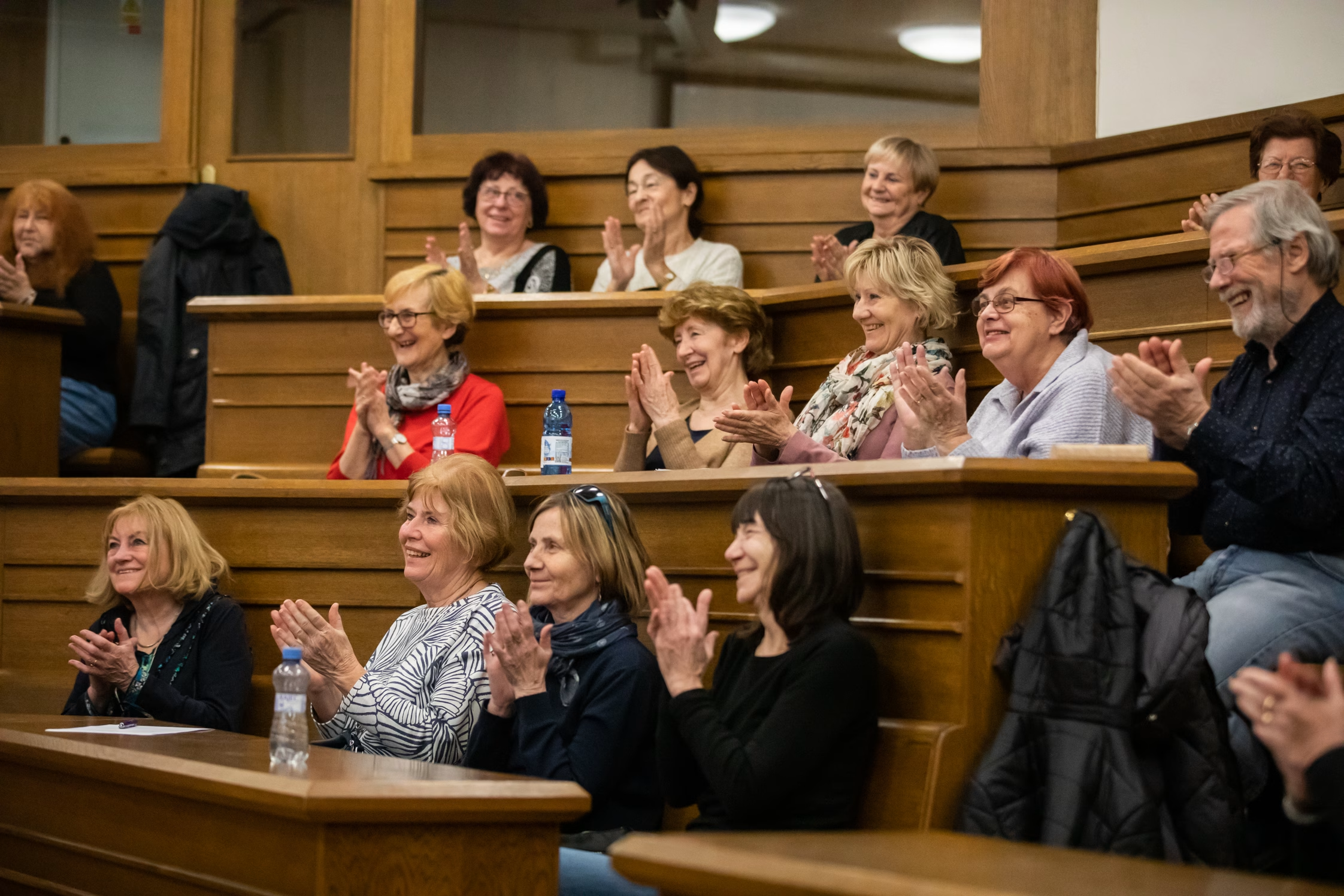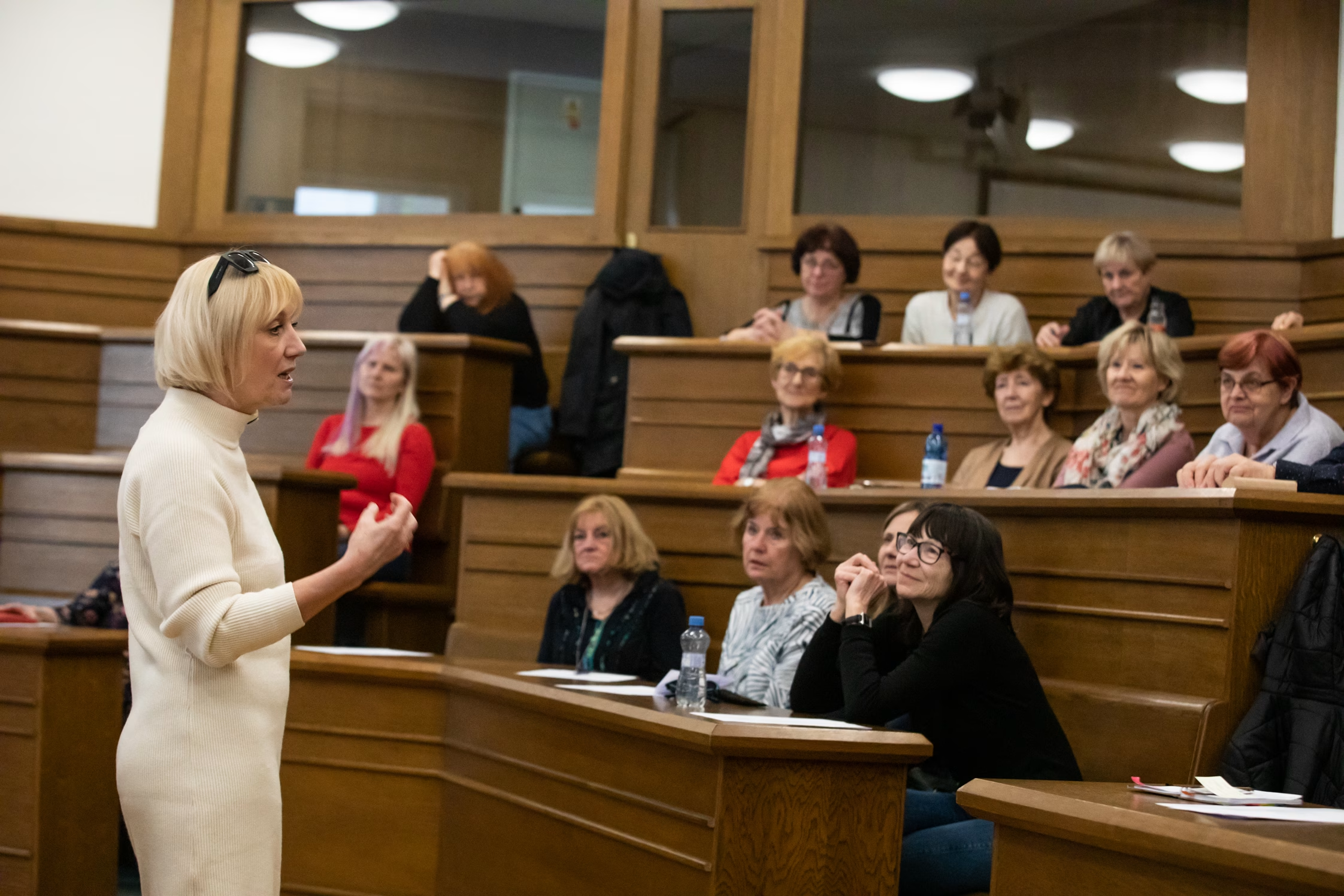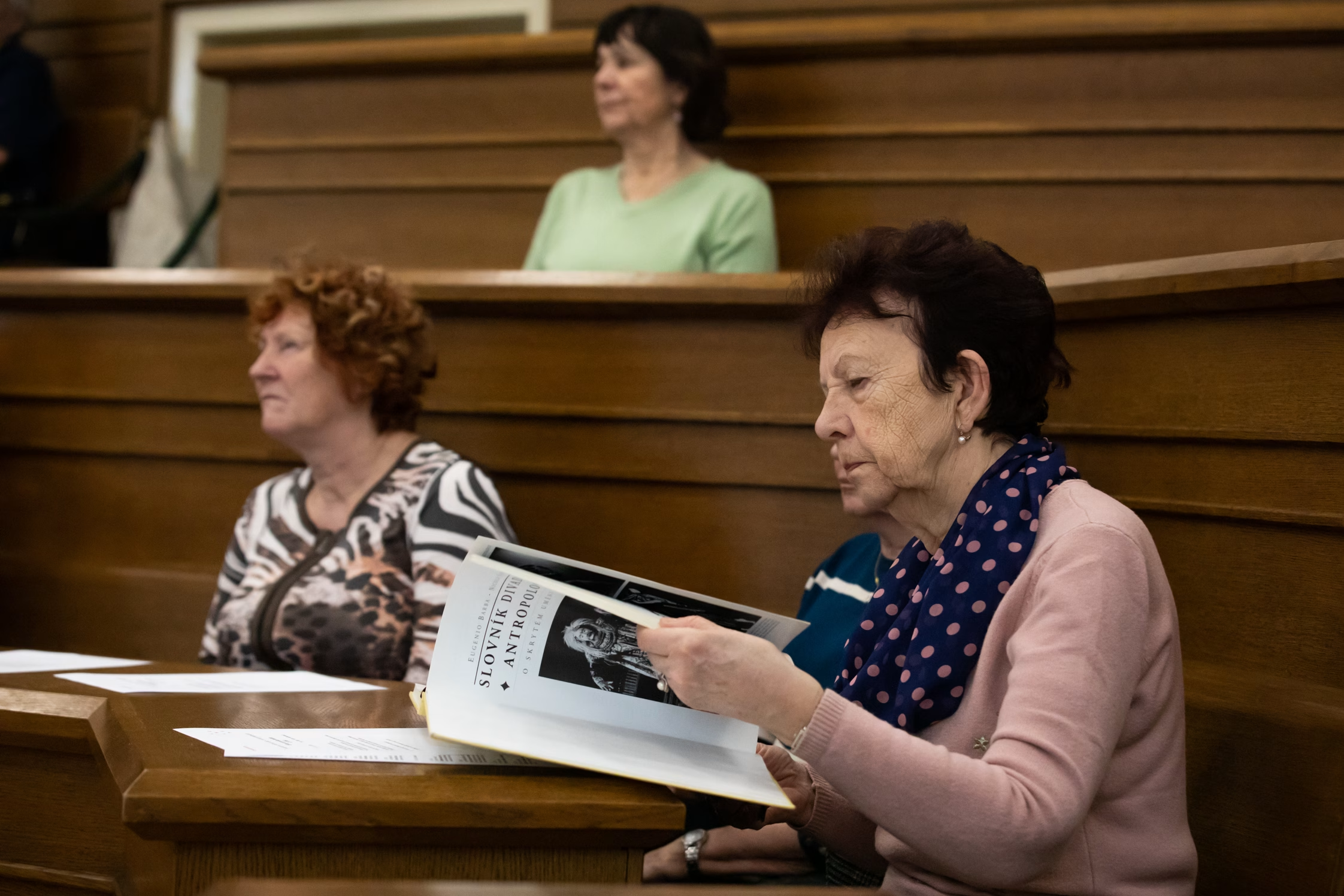

University of the Third Age is an educational programme designed for seniors who are interested in further development, learning about new fields and actively spending their free time. It offers the opportunity to broaden your knowledge while meeting people with similar interests.
We are currently running courses for the summer semester of the academic year 2025/26.
Basic information
The theme for the summer semester of the academic year 2025/26 is:
How Theatre XII is Created
Diversity of inspirations and creative practices in the creation of a production in theatre, radio and television (with possible references to the lecturer’s own work and experience)
This is a series of 10 lectures during the summer semester 2026.
The course will take place on Thursdays from 15:30 to 17:00 in classroom 104 (first floor) at the Theatre Faculty of JAMU, Mozartova 1, Brno from 5 March to 11 June 2026.
NOTE: Change of dates and possible change of lecture topics is subject to change.
Any citizen who has reached the age of 55, regardless of their educational level, and who fills in an application form at the JAMU Business Centre, is enrolled in the course and pays the enrolment fee, can become a U3V student at the JAMU Business Centre.
Anyone interested in the lecture series How Theatre XII is Created is obliged to fill in an application form at the JAMU Business Centre at: https://is.jamu.cz/obchod/baleni/14641
The deadline for applications at the JAMU Business Centre is 27 February 2026.
THE CURRENT COURSE IS MOMENTALLY SOLD OUT.
The registration fee is CZK 1.000,-. The course includes 10 lectures. A confirmation will be sent to you from the U3V coordinator based on the completed application form in the business centre.
5. 3. 2026
Mgr. Naďa Satková, Ph.D.
Much ado for the theory (of drama)
Annotation: At our practice-oriented academy, a course devoted to drama theory is firmly established in several of our study specialisations. How to teach it? How to convince learners of the importance of theory? And does such persuasion even make sense? The lecture will look at how to introduce students to something purely theoretical, when they themselves would most likely prefer to run straight into the whirlwind of practice and try and experience how theatre is made.
19. 3. 2026
doc. Mgr. Hana Halberstadt
Movement, a component of theatre productions of various genres
Annotation: In this lecture we will focus on the movement component of a theatre production, with regard to the differences in theatre genres, but also with regard to the personality of the director, the production key, and the diversity of the theatre space.
9. 4. 2026
prof. MgA. Ivo Krobot
On the principles of dramatisation
Annotation: the transformation of the original text into a theatre script and ultimately into the form of a production, documented by video recordings from my works at the Theatre at the Table, Dostoevsky – Tender, Hrabal – Too Noisy Solitude, Jirous – Magor. Dedicated to František Derfler and the great era of his theatre.
23. 4. 2026
Mgr. Petr Kobzev
Historical complexes and their audiovisual processing
Annotation: the lecture introduces the audience to Petr Zelenka’s neglected film Lost in Munich and discusses Jan Tesar’s book The Munich Complex, on which the film is based. The aim is to shed light on the phenomenon of historical turning points and often traumatic events that are not fully processed by the social whole of a nation, but which still reverberate and influence contemporary experience and perception of reality. The interpretation is interspersed with audiovisual examples from other countries: Croatia, Kazakhstan, Poland, etc.
30. 4. 2026
prof. Mgr. Petr Oslzlý
To be specified.
7. 5. 2026
doc. Břetislav Rychlík
HaDivadlo’s original acting or actors who inspire productions
Annotation: about the legendary dramaturgical achievement of Josef Kovalchuk, who in 1985 started a cycle of small authorial projects at HaDivadlo. The actors themselves came up with the themes, the idea of the creative team.
Přemysl Rut (in authorial collaboration with Břetislav Rychlík) – Today for the Last Time! – Břetislav Rychlík /1985
Slawomir Mrožek – Fairytales about the Fox – Tomáš Turek/1986
Miloš Černoušek, J. A. Pitínský – Deska – Miloš Černoušek/1986
Iva Klestilová, Hana Mullerová, Arnošt Goldflam – Daughters of the Nation /1987
Thanks to this project, for example, J. A. Pitínský appeared in professional theatre for the first time as a director (the production Deska in collaboration with Miloš Černoušek, now Cyril Drozda), and Martin Dohnal as an actor. One of the first directors was Jan Borna, a student at the time (Mrozek’s Fables of the Fox). Thus Iva Klestilová (Volánková) became a playwright and later a dramaturge. Břetislav Rychlík became an author and director.
A book on this topic has been published:
Actors of the “nation” or The journey of HaDivadlo actors, whom nobody knows, from Prostějov to Brno to the end of the world and back again / JAMU © 2024
21. 5. 2026
doc. MgA. Kateřina Jebavá, Ph.D.
Acting in time: rhythm, pause and timing as acting tools
Annotation: in this lecture we will focus on acting and how it is co-created by time: rhythm, pause, timing and the rehearsal process will be revealed as unique acting tools. We will observe how these tools change according to the situation and the medium – in theatre, radio and audiovisual – and how they influence the internal logic of acting on stage or in front of the camera.
4. 6. 2026
Mgr. Petra Rychecká
Compulsory non-required reading as a path to theatre?
Annotation: we will look together at literary stories, known as compulsory reading for schoolchildren and students, and at the ways in which drama education can work with them towards the creation of a theatrical form. We will be inspired by the educational programmes that are run for primary and secondary school pupils.
11. 6. 2026
Prof. PhDr. Veronika Broulíková
Inspiration and creation within the Theatre for the Deaf
Annotation: In this lecture we will focus on different perspectives on theatre by and for the Deaf, and not only for the Deaf.
NOTE: Change of dates and possible change of lecture topics reserved.
Coordinators
Guarantor